Things That Are Worth Serious Study: Sei Shōnagon's Pillow Book

I started writing (maybe you could call it that) at a young age. I remember my first True Piece of Literature (you definitely couldn't call it that) was penned entirely in green highlighter and told the story of a young cardinal named Stanley who was green. Had I had a red highlighter, I'm not sure if inspiration would have struck with the same force.
After that, I wrote predominantly in a diary. In the early aughts, that was a true-blue, came-with-a-fancy-digital-lock tangible diary with lined pages, but I abandoned that one pretty quickly as I always did. I'd compulsively want to buy notebooks I thought were pretty, much to my parents' dismay. I still have several, with little tidbits scattered across them from 2007 and 2017 and one day probably 2027, and while they're more of a laugh than a series of insights, I do love seeing how my voice developed, the things I noticed, these windows into my past self.

I think informal writings, unpublished writings--especially if written by women--are frequently considered lesser, as if only "high literature" is worth discussing. Thankfully, there have been shifts in that position. Say what you will about the ethical concerns in publishing works originally intended to be hyper-private (and you could say a lot), modern readers appreciate things like diaries as literature in their own right (see, e.g., Virginia Woolf, Sylvia Plath). And even diarists, compilers, and casual essayists lesser known for their other work (like Anaïs Nin) are recognized as talented written voices worthy of serious scholarship.

But what I had not realized is that seeing a woman's diary as true literature is not a new concept at all. For many, it's an ancient one. Nine hundred years before Nin, courtier Sei Shōnagon created a collection of observations, opinions, and witticisms* that became a cultural classic in Japan--as in "classic of mandatory school study," not "classic of an underrated gem beloved principally by English PhDs." (Though those are also good.) Smart, acerbic, and funny, even by modern standards, Shōnagon's work is evidence enough of the cultural and literary value of personal informal writing.

* It is difficult to classify this collection in English. While not a diary in the traditional sense, it is highly personal, anecdotal, and autobiographical. And it was perhaps kept hidden from others. Shōnagon wrote: "I have written in this book things I have seen and thought. . ., without ever dreaming that others would see it. . . I did my best to keep it secret, but despite all my intentions I’m afraid it has come to light." However, some people think this was an addition of ad-hoc demureness, and Shōnagon fully intended for people to read her work.

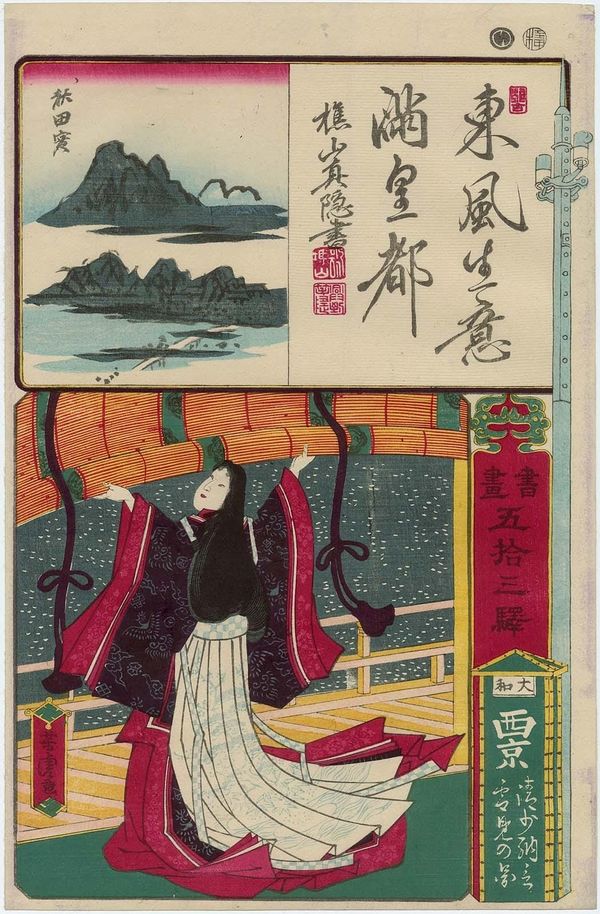
"Sei Shônagon Viewing the Snow," from the series Calligraphy and Pictures for the Fifty-three Stations of the Tôkaidô, Utagawa Yoshitora (1872) - Museum of Fine Arts Boston

Early Life

Sei Shōnagon was born in 966 or 967 somewhere in Japan. We know virtually nothing about her early or later life, instead deducing biographical tidbits from Shōnagon's own work and limited discussions of her in other sources. What I'm introducing here, then, reflects scholars' best attempt.

Shōnagon was born into a literary family, the Kiyoharas. It is possible that her real name was Kiyohara Nagiko (清原 諾子) which seems a little cuter than Shōnagon. Shōnagon (少納言) is actually a title meaning "lesser governmental councilor," a role that would have been held by a man. We can only explain half her now-used name. "Sei" is the Chinese-derived reading of "kiyo," the first character of her family name.* It may have been that the formula "bit of family name + man's governmental title" was the naming convention of imperial court ladies in her era. Or it may have been a kind of nickname for her due to a male relative who was actually a shōnagon. Or it may have just been funny to call her that. (Which is a real theory.) Regardless, my ignorant self will have to get over my Nagiko preference: she is near-universally referred to in scholarship as Shōnagon.

* For those like me who know next to nothing about Chinese or Japanese linguistics, in both ancient and modern Japanese, there are two ways to read kanji (Chinese characters used in Japanese writing). The first, on'yomi, reflects the Japanese approximation of the original Chinese pronunciation. The other, kun'yomi, is the Japanese translation of the word. In this instance, "sei" is the on'yomi reading of the first character of Shōnagon's family name and "kiyo" is the kun'yomi reading of the same character. Think of it this way: If English borrowed the character "枕" from Chinese, the on'yomi equivalent would be something like chin, a (likely doomed for most) attempt to replicate the Chinese pronunciation. The kun'yomi equivalent, the translation into English, would be "pillow." For Shōnagon's book, we use the "pillow" version, only in Japanese instead of English: makura. Thus, Makura no sōshi = The Pillow Book. We'll see more about the interesting divisions in writing and language a bit later, so if this bored you, don't worry: it gets worse.

Shōnagon's family descended from royalty (namely the Emperor Tenmu who reigned in the late 600s), but by the time of her birth, the family was primarily known for churning out writers. Both her father (Kiyohara no Motosuke) and grandfather (Kiyohara no Fukayabu) were poets. In addition to writing his own pieces, her father was one of several scholars that put together the Gosen wakashū poetry collection in approximately 951, which included some of Fukayabu's poems.

Shōnagon would carry this line forward and become a writer herself, and we know from her work that she was familiar with both Japanese and Chinese literature. Any other details about her as a child or a young student have been lost to time.

Even a bit past that, things get murky. It's possible Shōnagon got married circa 983 to a government official (Tachibana no Norimitsu) and possible that she had a son (Norinaga) from that relationship. But it's also possible they never married at all. We know the romance, if there was one, did not last.

A Lady-in-Waiting

What we have more definitively is the slice of Shōnagon's life as she entered the fascinating world of the cloistered imperial court of the Heian period (794-1185). Shōnagon's court era started around the year 993 when she was recruited as a lady-in-waiting to Empress Teishi (Fujiwara no Teishi; also known as Empress Sadako). The Empress was a favored consort of the Emperor Ichijō (who reigned from 986-1011) and herself a daughter of a powerful figure, Fujiwara Michitaka, the Chancellor of the imperial court.

Shōnagon became a favorite of the Empress Teishi, and Shōnagon adored her. That may be a bit of a chicken and egg issue, but it seems the devoted writings came after the favoritism. Or, some have speculated, came after development of a crush Shōnagon had on the Empress. Or both.

Things took a turn when Sadako's father died, and her uncle took over his substantial sphere of political influence. The uncle's daughter, Akiko (or Shōshi), supplanted Teishi as the Emperor's favorite.

Nonetheless, Shōnagon kept her allegiance to Teishi until the Empress died in childbirth in the year 1000 at the age of only 24. Then she left the court.

It's not clear what Shōnagon did next. It's possible she married an eventual provincial governor (Fujiwara no Muneyo) and had a daughter (Koma no Myōbu). There are enough theories about her later life to fill their own book. She may have died in a suburb in Tsukinowa in a family home. Or she may have entered a convent. Or she may have died destitute. I'm rallying for the first one. Whatever the case, Shōnagon died in approximately 1013, likely near Kyoto.

A painted fan inscribed with Sei Shōnagon's poem from the 'Hyakunin isshu'. (1989) © The Trustees of the British Museum.

A Writer

Though she also wrote poetry and other pieces, Shōnagon's most lasting work is Makura no sōshi (枕草子; literally "notes of the pillow"), called in English The Pillow Book. She began it while at the imperial court around 994 and finished it shortly thereafter in 1001.*

* Interestingly, the Empress's death is not a major feature of the work. Perhaps it was too painful to write about so soon afterwards.

Part of its renown comes from its unusual degree of modernity: the book is a collection of witty observances and opinions, penned by a whip-smart female writer who seems to revel in the whole enterprise. The "opinions" piece is key, for better or worse. Shōnagon was sharply observant, especially of the things she loved like beautiful clothing, nature, and art; parties at the court; and being Teishi's #1 fan and part of a high-level social circle of gossip and charm. At the same time, at least one contemporary, Murasaki Shikibu (herself the famed author of The Tale of Genji), saw her as ridiculous, arrogant, and over-the-top. Judgmental passages in The Pillow Book do little to combat this, with Shōnagon referring to being "disturbed by a herd of commoners" and annoyed by women "who are of no more value than a roof tile."

That elitism can be forgiven, at least in part, when considering the reclusive world Shōnagon was writing in, living in just a handful of rooms, surrounded only by women, where men speak from behind a screen. Writing is a way to experience freedom for many, but for Shōnagon, this was especially stark.

"Young woman reading 'The Pillow Book (makura no soshi)'," Katsushika Hokusai (1822) - Art Institute of Chicago, Clarence Buckingham Collection

So what is The Pillow Book?

A "pillow book" was, in Shōnagon's time, a personal diary: intended to be private, they were stored in places like pillows. It's not clear that this title is the name Shōnagon herself used, in part because no contemporary version of the book exists. It is rumored that it began circulating near-immediately when the actual book was purloined by an official in 995. However, the book has a Bible-like problem: absent an original copy, scribes tweaked the book at will, resulting in distinct versions of the text over time with different categories and even slightly different narrative voice. Today, the "true" Pillow Book is not a thing possible to pinpoint.

The book (as we now have it) consists of entries, like a diary, though only 50 or so can be dated and they aren't definitively ordered. They cover Shōnagon's time at the court, including her feelings, philosophies, and love affairs. They vary in form: some are discrete lists, others read like essays, a dozen or so are poems, and some are autobiographical pieces. She describes lovely bits of beauty like descriptions of flowers. She writes about things commonly lost to history, like women's pasttimes, descriptions of music, particular naming conventions, and even fashion and makeup. But in the same breath, though obliquely, Shōnagon tackled things like politics and gender dynamics. ("I can’t bear men who consider women who serve at court to be frivolous and unseemly. Though mind you, one can see why they would.")

The overall "triviality" critiqued in The Pillow Book can also be read as intentional. Scholars have also noted, correctly, that Shōnagon's refusal to write about political hierarchies and confining systems, especially after leaving the court in the wake of Teishi's downfall, can be read as subversive, a rejection of unpleasing things and confining institutions and a reclamation of the beautiful instead. As Shōnagon wrote: "Whether it be plants, trees, birds or insects, I can never be insensible to anything that on some occasion or other I have heard about and remembered because it moved or fascinated me."

The lists, in particular, are fantastic and reminiscent of Dorothy Parker, who graced the earth nearly 900 years later. They include titles such as "Things That Give a Pathetic Impression," "Things That Were Good in the Past But Are Useless Now," and "Things That Made My Heart Beat Faster." In "Infuriating Things," Shōnagon notes the indisputably infuriating thing where you think "of one or two changes in the wording after you’ve sent a message to someone." In "Things That Have Lost Their Power," she includes "balding men." As for "Things That Give a Pathetic Impression," Shōnagon includes only "The voice of someone who blows his nose while he is speaking. The expression of a woman plucking her eyebrows."

There are darkly funny passages, including a "Should I kill myself or have a cup of coffee?" predecessor. In a conversation with the Empress, the writer says, "At times, when I'm beside myself with exasperation at everything, I'm temporarily inclined to feel I'd simply be better off dead, or I'm longing to just go away somewhere, anywhere. Then if I happened to come by some lovely white paper for everyday use and a good writing brush, or white decorated paper or mikyunoku paper, I'm immensely cheered. And find myself thinking I might perhaps be able to go on living for a while longer after all." Sometime later, she's again in a dark mood and heads home, only to find "Her Majesty sent me a wrapped gift of 20 bundles of magnificent paper."

Her succinct defense of gossip also gave me a shameful chuckle: "I really can’t understand people who get angry when they hear gossip about others. How can you not discuss other people? Apart from your own concerns, what can be more beguiling to talk about and criticize than other people?"

"Sei Shonagon raising bamboo blind on view of snow scene," Eisai Rinzan (1806 or 1866) - © The Trustees of the British Museum.

From Pillow to Modern Press

The Pillow Book is a fascinating and incredibly rare glimpse into the Heian period. The start of the 11th century in Japan was a renaissance, profuse with art and literature and cultural achievement. Many, if not most, of the major writers in Shōnagon's time were also women, including Izumi Shikibu (a poet) and Murasaki Shikibu (diarist, writer of The Tale of Genji, and also the hater--or fair critic, maybe--from earlier).

In that era, Japanese male writers wrote prose in Chinese (kanji). These women did not. They wrote in what men disparagingly called onnade ("women's hand"), by which they meant hiragana, i.e., Japanese.* Thus, it was the work of women writers that became foundational examples of Japanese writing. To this day, Japanese schoolchildren are taught Shōnagon and Murasaki's works because of their "purity" (i.e., their use of Japanese writing over kanji). There is emphasis on Shōnagon in particular because of the very simplicity for which she was later critiqued: her sentences are far shorter than Murasaki's, and she uses (intentionally and stylistically) a high degree of repetition. Lovely things are almost always okashi ("charming") and medetashi ("splendid"). In fact, they are often very splendid (ito medetashi).

* Hiragana is only one part of modern Japanese writing, but it is distinctly Japanese.

However, the typical sexism of the past did not suppress Shōnagon's work, either in her lifetime or afterwards. The Pillow Book was always popular, and its popularity continued to the present day. In the fourteenth century, an elaborate scroll called the Makura no sōshi e-maki depicted various scenes from the book. And even in the last three decades, the work has inspired several English-language novels and the unnecessarily sexualized film version The Pillow Book (1996).

After its writing, an entire genre, zuihitsu (随筆) (literally "following the brush"), developed, featuring casual writing anthologies reflecting contemporary thoughts. In zuihitsu, the writer is not confined to a single topic or writing form or length of work. Little sentences about nature can exist alongside poems and personal anecdotes, just as they did in The Pillow Book.

Today's post was so much fun for me. I am woefully undereducated in historical east Asia and, because of that, a bit intimidated by diving into niche items of interest. But what an easy start, a book that reads like someone wrote it yesterday and that signals the prevailing power of women's wit.

Sources:

Subscribe to Deeply Unnecessary

Sign up now to get access to the library of members-only issues.
Jamie Larson
Subscribe