
Ice Joys Amid Ice Sads: The Origins of the Ice Cream Cone

Those who live in the South know well: it has been one of those weeks where we've been warned of a climate apocalypse. Buy all the milk and bread in the store! Keep your faucets dripping! Park somewhere, I don't know where, but not where you usually park! Of course, I don't mean to get too ahead of myself. Safety first, and power grids and winter drivers not used to winter are no joke. Hope everyone has stayed warm and well.
I've been thinking a lot about ice because, for me and many, it's become a ruined word lately. I look on with dismay at what is unfolding across the country and feel ashamed. At the same time, I feel a burn of solidarity every time I go to a protest or check in with a friend or donate to a cause. If we believe we are powerless, we are. And we are not. Please look into ways to help our friends in Minnesota here.
To start off this new little corner of the Internet I've created, I'd like to share a positive dive on the joys that immigrants and ice can bring. This is the story of the ice cream cone.
Cone Canon
In 1895, an Italian man named, fittingly, Italo Marchiony immigrated to the United States through Ellis Island. (As those with Ellis Island ancestral history know, last names proved... challenging for record keepers. Marchiony's surname is also recorded as Marchioni or Marcioni.) He was 20 years old. After a few moves, Marchiony settled in Hoboken, New Jersey and began to sell ice cream and lemon ice from a pushcart in New York City. Many Italian immigrants conducted similar work and were known as hokey pokey men. (Origin stories attribute the name to a little song the men sang or their cries of "Ecco un poco!" or "Here's a little!" and their neighbors' Italian leaving something to be desired.)
The story goes that a dismayed Marchiony found that, after kindly filling glass dishes with ice cream for his eager customers, they kept walking away with the dishes, never to return. (At least, not with the dishes. Probably for the ice cream.)
So Marchiony baked cup-shaped waffles to serve his wares. Great for his customers, not so great for Marchiony's free time. After hiring other push carters to keep up with waffle-cup demand, Marchiony simply could not keep up. He had struck dessert gold, for better or worse.
After seven years of work, Marchiony designed a device to mass-produce the waffle-cups, creating thinner sloped-side versions. He patented the handy machine in December of 1903.
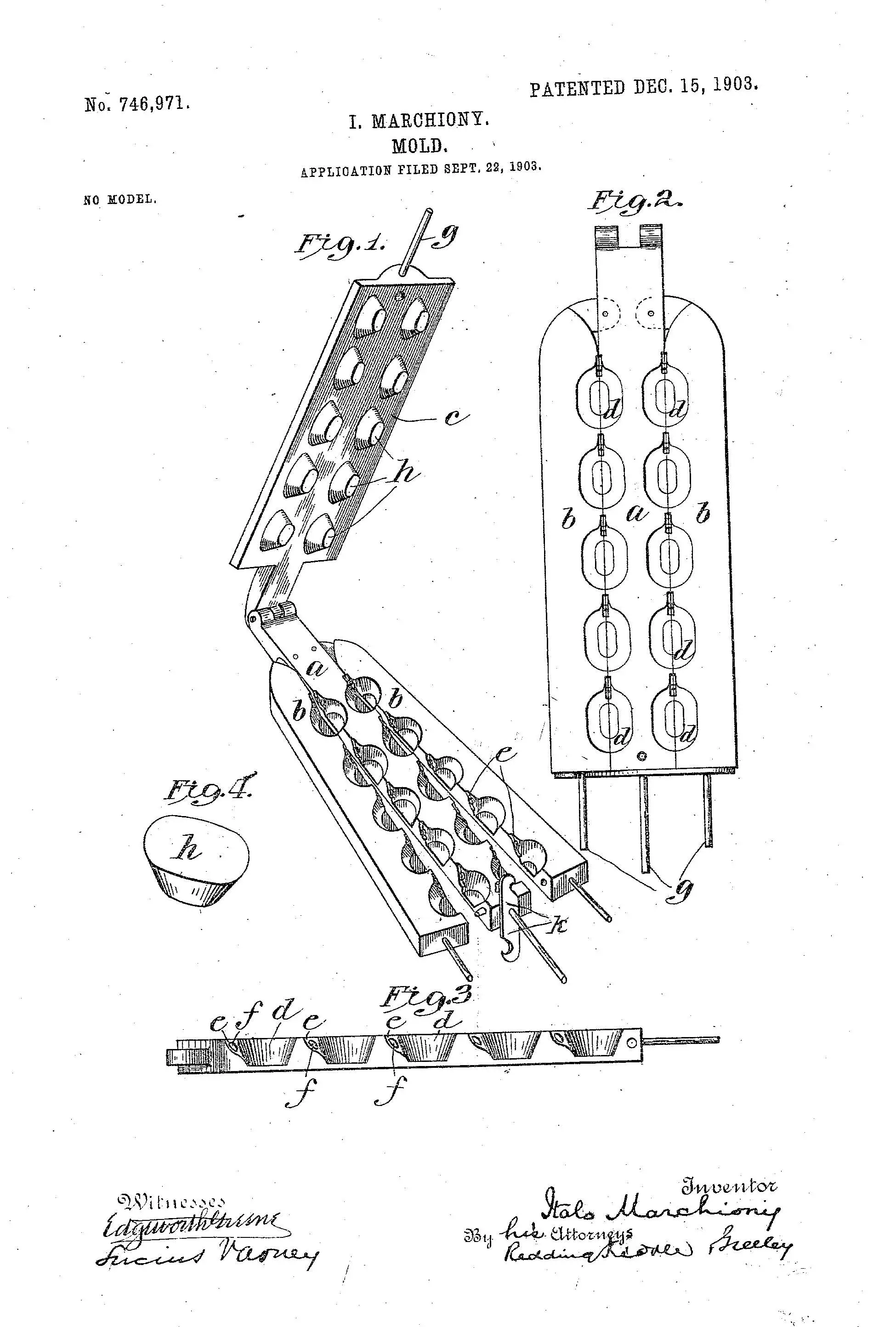
Marchiony died in his mid-80s in New Jersey and was survived by his wife and six children.
To be sure, dessert history arouses fierce passion and debate. I prefer to direct my fervor toward consuming them, but history is history. So did Marchiony invent ice cream? God, no. The hero who gave us frozen dairy is lost to ancient time. And can we definitively say he invented the ice cream cone? Maybe not. Some variant of an edible dessert-holder had existed for some time, and there are competing stories about who can truly claim the cone. (Many attribute the invention to another American immigrant, Ernest Hamwi, who served pastries inspired by zalabi, a sweet he knew from his native Syria, at the 1904 St. Louis World's Fair. But stories also say Hamwi stood alongside Marchiony at the fair, and Marchiony turned to Hamwi to craft the pastries into cups.) Arguably the above is the history of the ice cream cone U.S. patent, but that's not nearly as exciting a pitch. (My apologies to IP professionals.) My hope is the takeaway here is that diverse minds from diverse places make us better, sweeter, and delightfully fuller.
Sources:
- A History of Inventing in New Jersey, Linda J. Barth
- Children with ice cream cones, National Rice Festival, Crowley, Louisiana, Russell Lee, Farm Security Administration - Office of War Information Photograph Collection (Library of Congress)
- "The Italian American Dream," La Gazzetta Italiana
- "Italo Marchiony, 86, Made Ice Cream Cone," The New York Times
- "The Murky, Delicious History of the Ice Cream Cone," Alison Foster, National Geographic
- US746971A, Google Patents